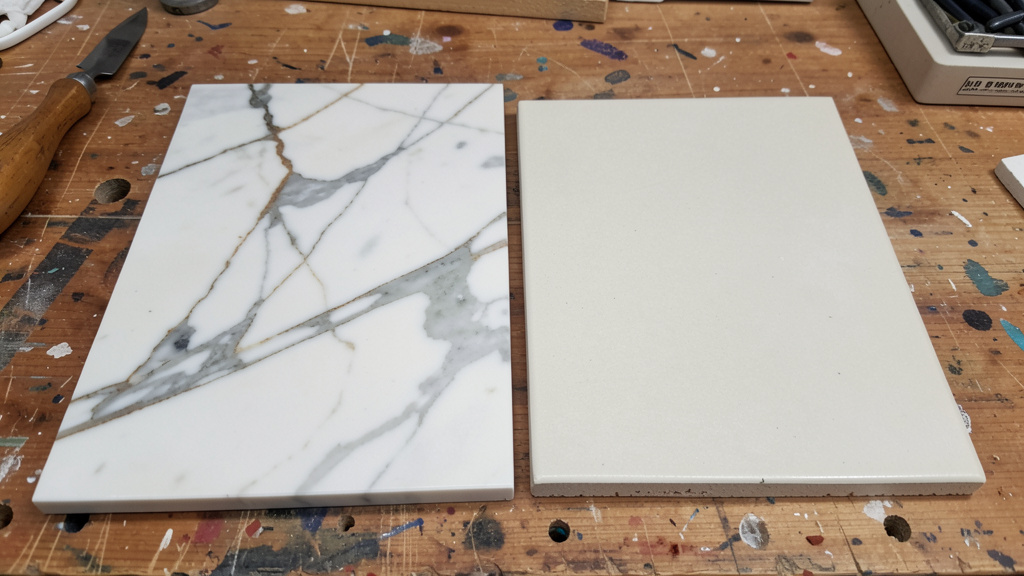
Navigate material decisions with clarity by aligning surface properties to your environment, usage patterns, and long-term care capacity—without marketing hype or oversimplified comparisons.
Selecting surfaces for your home involves more than visual appeal—it shapes daily functionality, maintenance rhythms, and resilience across seasons. Whether designing a kitchen backsplash, bathroom sanctuary, or outdoor living area, the choice between natural stone and manufactured tile requires thoughtful alignment with how you actually live. This guide provides a structured framework to evaluate materials through observable properties, environmental context, and realistic care expectations. Move beyond inspiration boards to make intentional choices grounded in material behavior, installation requirements, and lifecycle considerations.
Introduction
Showroom displays showcase polished slabs and photorealistic tiles under ideal lighting, yet rarely address how surfaces perform amid spilled coffee, pet traffic, or seasonal humidity shifts. A marble countertop admired in a magazine may develop etch marks from morning citrus in a busy household. Conversely, a durable porcelain floor might feel emotionally disconnected in a space meant for quiet reflection. This gap between aspiration and daily reality fuels frustration and premature replacements.
Material selection sits at the intersection of geology, engineering, and lived experience. Natural stone carries inherent variation shaped by geological history—each vein and fossil inclusion reflects millennia of transformation. Manufactured tile represents refined engineering—designed for consistency, targeted performance, and creative expression within controlled parameters. Neither category holds universal superiority; the optimal choice emerges only when material attributes align precisely with environmental demands, usage intensity, and personal values.
This resource synthesizes widely recognized industry standards (including ASTM, ISO, and TCNA guidelines), observed performance patterns across diverse climates, and practical considerations often overlooked in surface selection. We examine substrate compatibility, moisture dynamics, thermal behavior, and lifecycle implications—not as isolated technical details, but as interconnected factors influencing long-term satisfaction. By focusing on cause-and-effect relationships validated through field experience and material science, you gain a reliable foundation for decisions that support comfort, safety, and enduring beauty in your home.
The Material Matrix Framework: Four Dimensions for Confident Selection
Simplify complex choices by evaluating four interconnected dimensions. Overlooking any single dimension risks misalignment between expectation and reality. Apply this framework room by room to build clarity.
Dimension 1: Aesthetic Alignment – How Surfaces Evolve in Your Space
True aesthetic harmony considers how a material interacts with light, changes over time, and supports the emotional intent of a space—not just initial visual appeal.
Patina and Material Evolution
Natural stone often develops character with use. Honed marble may soften further with gentle cleaning; limestone can acquire subtle shadow lines in high-traffic zones; slate darkens slightly where moisture lingers. This evolution reflects engagement with daily life. High-quality porcelain maintains consistent appearance for decades. Neither path is inherently better—consider your perspective: Do you find meaning in surfaces that record lived experience, or prefer unwavering uniformity? There is no right answer, only personal resonance.
Light Interaction in Context
Showroom lighting distorts perception. Request large samples (minimum 12″x12″) and observe them in your actual space across multiple days:
– Morning light: How does east-facing sun interact with surface texture?
– Midday: Does polished granite create glare near a workspace?
– Evening: Does honed travertine cast a warm, diffuse glow under artificial light?
Matte finishes minimize reflections—ideal for media rooms or desks. Textured surfaces create dynamic shadow play that shifts with daylight angles. Always evaluate samples under your specific lighting conditions before deciding.
Scale, Pattern, and Spatial Perception
– Large-format tiles (24″x48″+): Minimize grout lines for seamless flow in open areas. In narrow hallways, oversized tiles may visually compress the space.
– Mosaic or small tiles (1″x1″–4″x4″): Add intricate detail perfect for shower niches or backsplash accents. Risk visual busyness on expansive floors.
– Natural stone slabs: Offer dramatic continuity but require careful layout planning to avoid awkward cuts at room edges.
Consider ceiling height, room proportions, and focal points. A busy pattern in a small powder room may feel overwhelming; the same pattern as a restrained accent strip in a spacious bathroom adds intentional artistry.
Color Stability Considerations
– Natural stone: Iron-rich varieties (certain sandstones, basalts) may develop subtle rust-toned shifts with prolonged moisture exposure if unsealed. Color variation between quarry blocks is inherent—request multiple samples from different lots.
– Manufactured tile: Through-body porcelain maintains color consistency even if chipped. Glazed ceramics or dyed tiles may show fading after years of direct sun exposure (relevant for sunrooms or south-facing entries).
Variation in natural materials isn’t a flaw—it’s authenticity. Ensure your tolerance for uniqueness matches the material’s inherent nature.
The Fundamental Principle: Aesthetic alignment means selecting a material whose visual language—texture, light response, scale, and evolution—supports the emotional purpose of the space and aligns with your relationship to change over time.
Dimension 2: Performance Demands – Matching Material to Environmental Stressors
Performance criteria are non-negotiable for safety, function, and longevity. Evaluate these factors rigorously based on your specific conditions.
Moisture and Humidity Exposure
– High-moisture zones (showers, steam rooms, pool surrounds): Prioritize materials with very low water absorption. Porcelain tile (<0.5% absorption) resists moisture penetration effectively. Among natural stones, dense granites (0.1–0.5% absorption) perform well when properly sealed; marble (0.5–2%) and limestone (5–15%) require vigilant maintenance and are generally less suitable for constant wet exposure.
– Critical note: Even sealed stone can experience moisture migration through microscopic fissures over time in steam environments. For submerged applications (pool interiors, fountain basins), specify materials explicitly rated for constant immersion—typically vitrified porcelain or select dense granites. Unglazed ceramic or porous limestone are not recommended below the waterline.
Thermal Dynamics
– Heat exposure: Granite withstands direct contact with hot cookware (tested to high temperatures). Marble tolerates heat but may develop hairline cracks if thermal shock occurs (e.g., hot pan on a cool, damp spot). Porcelain handles moderate heat well but benefits from trivets for extreme temperature shifts.
– Freeze-thaw cycles (outdoor applications): Water trapped in pores expands when frozen, causing surface spalling. Specify “frost-resistant” porcelain (absorption <0.1%) or verified dense granites for cold climates. Avoid limestone, sandstone, standard ceramic, and travertine in regions with freezing winters.
– Outdoor comfort: Light-colored surfaces reflect heat and stay cooler underfoot in hot climates. Dark materials absorb heat—consider foot comfort on pool decks or patios.
Abrasion, Impact, and Traffic
Refer to standardized ratings where available:
– PEI Scale (tile abrasion resistance):
– PEI III: Suitable for most residential floors (living rooms, kitchens)
– PEI IV–V: Recommended for entries, hallways, or homes with pets
– Mohs Scale (stone hardness):
– Granite (6–7): Resists scratches from grit, keys, or cookware
– Marble/Limestone/Slate (3–4): More susceptible to scratching; avoid in high-grit zones like mudrooms
Textured porcelain hides minor scratches better than polished surfaces. For spaces where falls are a concern (children’s areas, multi-generational homes), slightly resilient materials like cork tile offer impact absorption.
Slip Resistance – A Safety Priority
Glossy surfaces become hazardous when wet. Look for documented slip resistance values:
– DCOF (Dynamic Coefficient of Friction): ≥0.42 recommended for level interior wet areas; ≥0.60 critical for ramps, stairs, pool decks, or exterior zones.
Honed granite, flamed finishes, textured porcelain, and unglazed quarry tile provide reliable traction. Polished marble or high-gloss ceramic become slippery near water sources. Never judge slip resistance by appearance alone—request test reports from suppliers. For outdoor steps, specify tiles with integral texture or acid-etched finishes.
Chemical Exposure in Daily Use
– Acid sensitivity: Marble and limestone (calcium carbonate-based) react visibly with acids (citrus, vinegar, wine), creating dull etch marks. Granite and quartzite resist most household acids. Porcelain tile bodies are impervious, though grout lines remain vulnerable.
– Specialized environments: Pool surrounds require materials tested for chlorine/salt resistance. Craft rooms or labs benefit from chemical-resistant epoxy grout and verified tile specifications.
Always verify manufacturer guidance against your specific use case—general claims like “chemical resistant” require context.
Dimension 3: Budget Realities – Beyond the Price Tag
True cost encompasses material, installation complexity, maintenance investment, and replacement likelihood over decades.
Material Cost Spectrum (Installed Estimates – Regional Variations Apply)
– Value Tier ($3–$10/sq. ft.): Standard ceramic tile, basic quarry tile. Suitable for low-traffic areas, accent walls, or projects where longevity is secondary.
– Balanced Tier ($10–$25/sq. ft.): Porcelain tile (including wood/stone visuals), mid-range granite, slate. Strong balance of durability, aesthetics, and long-term value for primary living spaces.
– Distinctive Tier ($25–$75+/sq. ft.): Exotic marbles, book-matched slabs, handmade cement tiles, large-format porcelain panels. Justified for focal points where emotional resonance and uniqueness are priorities.
– Artisan Tier ($75+/sq. ft.): Rare quartzites, fossiliferous limestone, custom mosaic installations. Reserved for statement elements where material itself serves as artwork.
Note: These ranges reflect typical installed costs but vary significantly by region, project complexity, and market conditions. Obtain localized quotes.
Installation Complexity Factors
Material choice directly impacts labor requirements:
– Large-format tiles (>24″x24″): Require near-perfect substrate flatness. Existing uneven floors may need self-leveling compound ($2–$5/sq. ft. additional).
– Natural stone slabs: May require specialized handling equipment and layout planning for seam placement.
– Intricate patterns (herringbone, Versailles): Increase labor time by 30–50% versus straight layouts.
– Thickness variation (some slates): Demands installer expertise to achieve consistent grout lines.
Always secure installation quotes before finalizing material selection. A lower-cost material requiring extensive substrate prep may exceed the installed cost of a higher-grade option needing minimal preparation.
Long-Term Maintenance Investment
Calculate realistic annual upkeep:
– Natural stone: Sealing every 1–3 years ($0.50–$2/sq. ft. for materials or professional service). Acidic spills require prompt attention.
– Porcelain tile: Primarily grout maintenance. Epoxy grout eliminates sealing needs but costs more upfront. Cementitious grout benefits from annual sealing in wet areas.
– Hidden labor: Daily wiping of porous surfaces versus weekly mopping of impervious tiles. Time spent cleaning grout lines.
For busy households, the cumulative time investment of high-maintenance surfaces often outweighs initial material savings. Match the surface’s care requirements to your actual habits, not an idealized routine.
Resale and Longevity Perspective
Consider regional buyer expectations: Coastal markets often prioritize moisture-resistant surfaces; historic districts may value authentic materials. Neutral, timeless choices (warm whites, soft grays, natural textures) maintain broad appeal. However, a thoughtfully executed unique feature (a preserved tile mural in a period home) can become a celebrated asset. Research local trends through real estate professionals. Remember: Replacing flooring mid-ownership is disruptive and costly. Investing modestly more upfront in versatile, durable materials frequently yields greater long-term satisfaction.
Dimension 4: Lifestyle Compatibility – Honesty About Daily Realities
This dimension bridges idealized visions and lived experience. Answer these questions candidly.
Household Activity Profile
– Active households (children, pets, frequent entertaining): Prioritize durability, stain resistance, and easy cleanup. Textured porcelain hides scratches and paw prints. Avoid polished stone (shows water spots) or light grout (reveals dirt). Choose grout colors closely matching the tile.
– Low-traffic sanctuaries (adults-only, minimalist): Embrace materials requiring gentle care. Honed marble develops a cherished patina. Delicate mosaics create artistic focal points.
– Multi-generational or accessibility-focused homes: Safety is paramount. Specify slip-resistant surfaces (DCOF ≥0.60), consistent textures to prevent tripping, and avoid dramatic level changes. Radiant heating enhances comfort for mobility-sensitive individuals.
– Rental properties or investment flips: Focus on repairability and broad appeal. Standard-sized mid-tone porcelain withstands tenant turnover. Avoid obscure sizes that complicate future repairs.
Personal Maintenance Threshold
Be realistic about your capacity:
– Do you find ritualistic care (seasonal sealing, dedicated cleaning routines) satisfying?
– Or does “low maintenance” mean “wipe with a damp microfiber cloth”?
– If you travel frequently, materials requiring regular sealing become challenging.
– If cooking with turmeric or red wine is routine, avoid porous light-colored surfaces.
Select surfaces whose care rhythm aligns with your actual life—not an aspirational version. Satisfaction stems from alignment between expectation and reality.
Emotional Resonance
Stand before your top contenders. Does the material evoke calm, warmth, energy, or sophistication? Does it feel authentic to your story? Reclaimed brick tile may resonate with heritage values; sleek matte porcelain might align with modernist aesthetics. This intangible connection matters deeply. A surface you emotionally connect with will feel worth its care requirements. Conversely, choosing solely for durability without resonance often leads to dissatisfaction. Balance practicality with meaning.
Natural Stone Deep Dive: Understanding Geological Families
Natural stone encompasses diverse geological formations, each with distinct properties shaped by mineral composition and formation history. Understanding these origins helps predict performance.
Granite: Dense and Durable
Formed from cooled magma, granite is an igneous rock composed of interlocking quartz, feldspar, and mica crystals.
Key Properties
– Hardness: 6–7 on Mohs scale (resists scratches from everyday use)
– Absorption: Very low (0.1–0.5%)—performs well in wet areas when sealed
– Heat tolerance: Handles direct contact with hot cookware effectively
– Variation: Moderate. Patterns range from subtle speckles to dramatic movement
Best Applications
Kitchen countertops, bathroom vanities, fireplace surrounds, high-traffic flooring, outdoor kitchens (dense varieties verified for climate). Note: Slabs require seams; placement affects visual flow and structural integrity.
Maintenance Considerations
Seal periodically (test annually with water droplet test—beading indicates effective sealant). Clean with pH-neutral stone soap. Avoid acidic cleaners that degrade sealant over time. Minor surface scratches often blend into speckled patterns. Chips at edges can be repaired with color-matched epoxy by professionals.
Common Considerations
– Geological accuracy: Some stones marketed as granite (e.g., “Black Galaxy”) are technically gabbro. Verify composition with suppliers if critical for performance.
– Seam placement: Review slab layout before fabrication. Avoid seams near sink cutouts or high-stress zones.
– Color stability: A few granites (e.g., Kashmir Gold) may darken slightly with prolonged UV exposure—consider for sun-drenched rooms.
Illustrative Example
A household selected a medium-gray granite with subtle movement for their active kitchen. After several years, minor surface marks near the prep area remain visually integrated within the stone’s natural pattern. Annual sealing before summer entertaining season maintains performance. The surface has accommodated daily cooking, occasional dropped items, and family use without significant wear—demonstrating granite’s resilience when matched to appropriate usage.
Marble: Elegant with Character
Metamorphosed from limestone, marble is prized for luminous quality and distinctive veining. Primarily composed of calcite or dolomite, it interacts uniquely with its environment.
Key Properties
– Hardness: 3–4 on Mohs scale (more susceptible to scratching)
– Absorption: Moderate (0.5–2%)—requires consistent sealing
– Reactivity: Develops etch marks (dull spots) upon contact with acids (citrus, vinegar, wine)
– Variation: High. No two slabs are identical; veining ranges from delicate to bold
Best Applications
Bathroom vanities (lower acid exposure), fireplace surrounds, accent walls, low-traffic flooring. Generally not recommended for primary kitchen countertops unless the user embraces etching as part of the material’s evolving character.
Maintenance Considerations
Seal every 6–18 months based on usage and sealant type. Wipe spills promptly, especially acids. Use coasters under glasses. For honed finishes, mild etch marks may be gently addressed with baking soda paste; polished finishes typically require professional attention for significant etching. Many appreciate etching not as damage, but as evidence of use—a developing patina.
Common Considerations
– Finish choice: Honed (matte) marble hides etching better but shows scratches more visibly. Polished marble highlights veining but makes etching starkly apparent. Select based on tolerance and usage context.
– Composition awareness: Some green marbles contain serpentine, which is softer than calcite-based marble. Verify composition for high-use areas.
– Climate limitations: Avoid outdoor use in freeze-thaw climates due to moisture vulnerability.
Illustrative Example
A homeowner chose honed Carrara marble for a primary bathroom vanity. Morning routines include toothpaste (mildly acidic), which leaves subtle interaction marks over time. After several years, the surface developed a soft, satin patina the owner finds more personally meaningful than the original showroom appearance. Biannual sealing and dedicated stone cleaner maintain integrity—a care routine embraced as part of the space’s ritual.
Limestone and Travertine: Earthy and Textural
Sedimentary rocks formed from compressed marine fossils and minerals. Limestone offers uniform matte finishes; travertine features characteristic porous voids (often filled during fabrication).
Key Properties
– Hardness: 3–4 on Mohs scale
– Absorption: Moderate to high (limestone 5–15%; travertine 2–10% even when filled)—requires robust sealing
– Texture: Limestone provides smooth warmth; travertine offers tactile, organic character
– Color range: Warm beiges, taupes, creams—ideal for grounded, serene spaces
Best Applications
Bathroom walls/floors (with diligent sealing), fireplace surrounds, low-traffic living areas, outdoor patios in arid climates. Avoid in kitchens, mudrooms, or areas with frequent acidic exposure.
Maintenance Considerations
Seal annually with penetrating sealer. Clean with stone-specific pH-neutral products. Avoid steam mops that force moisture into pores. For travertine, periodically inspect filled voids; re-fill if chips occur. Stains may require poultice treatments. These materials show wear gracefully—they are intended to feel lived-in.
Common Considerations
– Filled vs. unfilled travertine: Unfilled has open voids that collect debris—beautiful but higher maintenance. Filled travertine (voids patched with resin/cement) is more practical for floors. Confirm filling method with supplier.
– Acid sensitivity: Even mild cleaners can etch limestone. Use only stone-safe products.
– Slip potential: Honed limestone provides good dry traction but becomes slippery when wet. Specify textured finishes for shower floors.
Illustrative Example
Filled travertine tile was installed on a covered patio in a dry-climate home. The stone’s earthy tones complement the landscape. Annual sealing before rainy season maintains performance. After several years, minor surface marks from patio furniture blend into the textured surface. The light color helps keep the area cooler underfoot—a practical benefit of material choice aligned with climate.
Slate and Sandstone: Rustic with Limitations
Slate (metamorphic) and sandstone (sedimentary) offer distinctive textures suited to specific contexts.
Slate Considerations
– Properties: Naturally cleft surface provides excellent slip resistance; cleaves along planes; absorption varies (0.5–5%)
– Best for: Exterior walkways (in suitable climates), fireplace hearths, rustic bathrooms
– Cautions: Thickness variation requires skilled installation for even setting. Edges can chip under sharp impact. Not suitable for countertops. Verify true slate (produces clear ring when tapped) versus softer substitutes.
Sandstone Considerations
– Properties: Granular texture; absorption often high (up to 20%); iron content may cause staining
– Best for: Dry-climate exterior walls, garden paths in arid regions
– Cautions: Highly vulnerable to moisture damage. Avoid in wet areas, freeze-thaw zones, or high-traffic floors. Requires heavy-duty sealing and climate-appropriate placement.
Manufactured Tile Deep Dive: Engineered Solutions
Manufactured tiles leverage material science to address specific performance needs while expanding design possibilities. Understanding composition clarifies true capabilities.
Porcelain Tile: Engineered for Resilience
Made from refined clays and minerals fired at high temperatures (1,200–1,400°C), achieving density with water absorption ≤0.5%.
Through-Body vs. Glazed Porcelain
– Through-body: Color and pattern extend throughout the tile. Surface chips remain visually subtle. Ideal for high-traffic floors, commercial spaces, outdoor areas. Often features subtle texture for slip resistance.
– Glazed: Decorative layer fused to surface. Enables realistic wood, stone, or fabric visuals. Glaze provides stain resistance; chips may reveal contrasting body color. Best for walls, low-impact floors, or areas where aesthetics outweigh chip risk.
Performance Advantages
– Freeze-thaw stability: Impervious to moisture penetration—suitable for cold-climate exteriors when rated “frost-resistant.”
– Chemical resistance: Unaffected by household acids, alkalis, or pool chemicals.
– Consistency: Minimal batch variation supports large projects.
– Format versatility: Available up to 60″x120″ for expansive, low-grout applications.
Best Applications
Kitchen floors, bathroom walls/floors, shower surrounds, outdoor patios/decks (verified frost-resistant), pool surrounds (textured, high-DCOF), commercial entries.
Maintenance Considerations
Tile body requires minimal care—clean with mild detergent. Grout lines determine ongoing maintenance: epoxy grout eliminates sealing needs; cementitious grout benefits from sealing in wet areas. Avoid abrasive pads on high-gloss glazes. Textured surfaces may require periodic grout-line brushing.
Technology Note
Advanced digital printing replicates natural materials with remarkable accuracy. Micro-texturing adds tactile authenticity. View large samples in natural light—low-resolution prints may appear artificial up close. Quality varies significantly between manufacturers; request full-size samples.
Illustrative Example
A family installed large-format (24″x48″) wood-look porcelain throughout their main living area. With pets and frequent gatherings, durability and easy cleanup were priorities. After several years, the surface shows no visible wear, stains, or scratches. Guests often mistake it for real wood. Weekly mopping with pH-neutral cleaner maintains appearance—no sealing, refinishing, or special protocols required. The choice aligned perfectly with their active lifestyle and maintenance preferences.
Ceramic Tile: Accessible and Versatile
Fired at lower temperatures than porcelain, with higher water absorption (3–10%). Best suited for interior, low-moisture applications.
Glazed Ceramic
Decorative glaze provides color variety and stain resistance. Body is typically red or white clay. Ideal for interior walls, backsplashes (away from direct sink/stove splash zones), and dry-area accents. Not recommended for showers, floors in wet zones, or exterior use where moisture penetration risks cracking.
Quarry Tile
Unglazed, extruded ceramic with natural iron content. Offers inherent slip resistance and develops a rich patina. Classic for mudrooms, historic restorations, or commercial kitchens. Requires sealing due to porosity. Avoid in freeze-thaw environments.
Value Consideration
Typically 20–40% less expensive than porcelain. A practical choice for budget-conscious projects in appropriate settings (powder room walls, low-splash backsplashes). Always verify suitability for the specific location—cost savings are negated by premature failure.
Specialty Manufactured Options: Targeted Applications
Cement Tile (Encaustic)
– Composition: Hand-poured layers of cement, sand, and mineral pigments. No firing.
– Appeal: Vibrant, intricate patterns; each tile unique. Develops a soft patina.
– Reality: Highly porous—requires sealing before and after installation. Stains easily from oils or dyes. Not recommended for kitchens, bathrooms, or high-moisture zones. Best for dry-area accent walls, fireplace surrounds, or protected entries.
– Planning tip: Order 15–20% overage due to batch variation; essential for future repairs.
Glass Tile
– Composition: Recycled or virgin glass.
– Appeal: Luminous, reflective; impervious to moisture and stains.
– Best for: Shower niches, backsplash accents, areas benefiting from light reflection.
– Considerations: Shows water spots and soap scum; benefits from post-shower squeegeeing. Not suitable for floors (slip risk when wet) or high-impact zones. Requires flexible adhesive and grout to accommodate movement.
Metal Tile (Stainless Steel, Copper, Zinc)
– Appeal: Industrial aesthetic; copper offers antimicrobial properties.
– Reality: Shows fingerprints, water spots, and scratches readily. Requires specific maintenance (e.g., copper develops patina unless polished). Best used sparingly as accents (backsplash behind range). Ensure substrate is perfectly flat—imperfections telegraph through thin tiles.
Engineered Quartz Surfacing
– Note: Typically installed as slabs (90–95% ground quartz bound with polymer resins), not tile.
– Advantages: Non-porous—never requires sealing. Highly resistant to stains and scratches.
– Considerations: Resins may discolor under extreme, prolonged heat (always use trivets). Some formulations may fade with constant direct sunlight. Seams are visible.
– Best for: Kitchen countertops, bathroom vanities where minimal maintenance is prioritized.
Critical Decision Pathways: Context-Specific Guidance
Move beyond general comparisons with these scenario-based frameworks.
Kitchen Countertops: Navigating Daily Demands
| Factor | Natural Stone (Granite) | Manufactured (Quartz / Porcelain) |
|---|---|---|
| Heat Exposure | Handles direct hot pan contact effectively | Quartz resins may discolor under extreme prolonged heat; porcelain tile benefits from trivets |
| Stain Resistance | Good when sealed; prompt spill cleanup essential | Excellent (non-porous); spills wipe clean easily |
| Acid Exposure | Resistant (granite inert to household acids) | Resistant |
| Scratch Resistance | Very good (Mohs 6–7) | Excellent (quartz Mohs ~7; porcelain varies by glaze) |
| Seam/Grout Visibility | Moderate (epoxy seams blend well) | Quartz: visible seams; Porcelain tile: grout lines present |
| Repairability | Surface damage often repairable by professionals | Quartz chips difficult to repair invisibly; tile chips require replacement |
| Best Suited For | Cooks valuing heat tolerance, natural variation, timeless appeal | Households prioritizing low maintenance, consistent appearance, stain resistance |
Decision Pathway
– If hot cookware contacts the surface daily without trivets: Granite offers reliable heat tolerance.
– If stain anxiety is high (red wine, turmeric, oils): Quartz or porcelain provides peace of mind.
– If seamless appearance is critical but budget limits slab options: Large-format porcelain panels (emerging option) minimize grout lines.
– If budget-constrained but durability needed: Porcelain tile countertop with epoxy grout (requires skilled installation to minimize grout exposure in high-use zones).
Bathroom Floors: Prioritizing Safety and Serenity
| Factor | Natural Stone (Slate, Honed Granite) | Manufactured (Textured Porcelain) |
|---|---|---|
| Wet Slip Resistance | Good to excellent (naturally cleft slate) | Excellent (specify DCOF ≥0.60 for shower floors) |
| Underfoot Comfort | Cool; benefits from radiant heating | Cool; same consideration |
| Maintenance Focus | Stone requires sealing; grout lines vulnerable | Tile body impervious; grout maintenance key (epoxy recommended for wet zones) |
| Aesthetic Character | Organic, spa-like authenticity | Convincing stone/wood visuals available; consistent appearance |
| Installed Cost Range | Moderate to premium | Value to moderate |
| Ideal Context | Primary bathrooms with budget for authentic texture and care | All bathrooms; especially powder rooms, children’s baths, rental properties |
Critical Insight
Grout is often the maintenance focal point. In shower floors, epoxy grout significantly reduces staining and mildew concerns regardless of tile choice. For stone installations, ensure pH-neutral setting materials are used to prevent etching during installation. Proper slope (¼” per foot toward drain) is non-negotiable—material choice cannot compensate for inadequate drainage.
Outdoor Living Spaces: Climate as the Deciding Factor
| Climate Challenge | Recommended Material | Key Rationale |
|---|---|---|
| Freeze-Thaw Cycles | Frost-resistant porcelain (absorption <0.1%) | Prevents moisture penetration and spalling |
| Verified dense granite pavers | Natural option when absorption and installation are validated | |
| Avoid | Limestone, sandstone, standard ceramic, travertine | High absorption leads to deterioration |
| Intense Sun/Heat | Light-colored porcelain or stone | Reflects heat; stays cooler underfoot |
| Textured surfaces | Hides minor UV fading better than high-gloss | |
| Avoid | Dark materials (heat absorption), some dyed ceramics (potential fading) | Comfort and longevity considerations |
| Coastal/Salt Air | Porcelain tile, granite | Resists salt corrosion effectively |
| Avoid | Limestone, marble (salt accelerates surface erosion) | |
| High Rainfall | Textured porcelain, flamed granite | Maximizes slip resistance when wet |
| Critical | Verify drainage slope (minimum ⅛” per foot away from structures) |
Installation Essentials for Outdoors
1. Substrate: Minimum 4″ reinforced concrete slab with control joints.
2. Mortar: Polymer-modified thinset rated for exterior use.
3. Expansion joints: Required every 8–12 feet; filled with flexible sealant to accommodate movement.
4. Grout: Epoxy or premium cementitious grout with latex additive; seal annually in harsh climates.
5. Pitch verification: Confirm slope with level before tile setting—water must flow away from structures.
Skipping foundational steps risks premature failure. Prioritize installers with documented outdoor project experience in your climate zone.
Sustainability Considerations: Evaluating Lifecycle Impact
“Eco-friendly” requires nuanced evaluation across the material lifecycle.
Natural Stone
– Extraction: Quarrying impacts landscapes; reputable operations implement land reclamation and water recycling. Stone contains no synthetic binders.
– Processing: Cutting/polishing consumes energy and water; modern facilities increasingly adopt closed-loop water systems. Waste rock is often crushed for aggregate.
– Transportation: Heavy material = higher transport emissions. Sourcing regionally (e.g., U.S. granite from Vermont/Georgia) reduces footprint.
– Longevity: With proper care, stone surfaces can remain functional for generations, reducing replacement frequency.
– End-of-life: Fully recyclable as aggregate; inert in landfills.
– Verification: Look for NSF/ANSI 373 certification (sustainable processing) or regional material credits (LEED).
Manufactured Tile
– Raw materials: Abundant clays and minerals; many brands incorporate recycled content (post-consumer glass, porcelain waste)—inquire about percentages.
– Firing: Energy-intensive; leading manufacturers utilize renewable energy, heat-recapture systems, and efficient kilns.
– Transportation: Lighter weight than stone slabs can reduce shipping emissions per square foot.
– Longevity: Quality porcelain lasts decades, minimizing replacement waste.
– End-of-life: Crushed tile (“tilecrete”) is widely accepted for road base or aggregate.
– Verification: Green Squared certification (comprehensive sustainability standard), Cradle to Cradle, or Environmental Product Declarations (EPDs).
Balanced Perspective
No single category is universally “greener.”
– For minimal processing impact: Regionally sourced natural stone (if local quarries exist with responsible practices).
– For recycled content and manufacturing innovation: Porcelain with documented recycled content from certified sustainable manufacturers.
– For longest service life: Both categories excel when correctly specified and installed—durability itself is a sustainability feature.
Request documentation from suppliers. Ask: “What percentage of raw materials is recycled?” “What energy sources power production?” “Are third-party sustainability certifications available?” Informed choices support responsible practices.
Installation Fundamentals: Foundations of Longevity
Material selection accounts for only part of the outcome. Installation quality critically influences performance and lifespan.
Substrate Preparation: The Critical Base
Core Principle: Installation integrity depends entirely on substrate condition.
– Floors: Must be structurally sound (no deflection), flat (≤⅛” variation in 10 feet), and clean. Plywood subfloors require cement backer board (½” minimum) securely fastened. Concrete slabs must be crack-free, clean of curing compounds, and moisture-tested.
– Walls: Must be plumb and flat. Use cement board or glass-mat water-resistant backing in wet areas—greenboard is not recommended for tile applications.
– Common error: Installing over vinyl flooring, particleboard, or cracked concrete. Movement or moisture migration causes debonding or cracking. Proper preparation adds cost but prevents costly repairs later.
Moisture Testing for Concrete Slabs
1. Tape an 18″x18″ plastic sheet tightly to the slab.
2. Wait 72 hours.
3. Condensation under the plastic indicates excessive moisture vapor emission.
4. Solution: Apply a moisture mitigation membrane before proceeding. Skipping this risks adhesive failure and mold growth beneath the surface.
Adhesive and Grout Selection: Chemistry Matters
Thinset Mortar Types
– Unmodified: Powder mixed with water. Requires porous substrate (cement board) for proper curing.
– Modified (Polymer-Enhanced): Contains latex additives for flexibility and stronger bond. Recommended for porcelain, large-format tiles, and all wet areas.
– Critical note: Mastic (premixed adhesive) is not suitable for floors, showers, or areas exposed to moisture—it can re-emulsify when wet. Avoid below-grade installations.
Grout Selection Guide
– Sanded grout: For joints ≥⅛”. Provides structural integrity; use for floors and large tiles.
– Unsanded grout: For joints <⅛” (polished stone, small mosaics). Prevents surface scratching.
– Epoxy grout: Two-part resin system. Stain-proof, mold-resistant, no sealing required. Ideal for showers, kitchens, and high-moisture zones. Higher material cost and shorter working time, but long-term maintenance benefits often justify investment.
– Color strategy: Matching grout to tile creates visual continuity and hides soil on floors. Contrasting grout makes a graphic statement but requires meticulous cleaning. Avoid pure white grout on floors—it highlights every particle of dirt.
Expansion Joints: Accommodating Movement
All materials expand and contract with temperature and humidity changes. Without relief joints, stress cracks tiles or grout.
– Perimeter joints: Maintain ¼” gap between tile and walls; fill with flexible sealant (silicone), not rigid grout.
– Field joints: In large areas (>20 ft), install movement joints every 20–25 ft using flexible profiles.
– Transitions: Use movement-compatible profiles at doorways or where materials change (tile to wood).
Omission of expansion joints is a frequent cause of cracking appearing months after installation. Specify compliance with TCNA (Tile Council of North America) Handbook guidelines during planning.
Installer Qualification Considerations
Invest time in vetting:
1. Ask about certifications (CTEF, NTCA) or documented training.
2. Request photos of completed projects similar to yours.
3. Inquire about labor warranties (reputable installers often provide 1–5 years).
4. Confirm moisture testing protocols for slabs.
5. Verify use of modified thinset for porcelain/large-format installations.
Considerations: Lack of physical business address, reluctance to provide references, or cash-only payment terms may indicate higher risk. Skilled installation is an investment that protects your material choice.
Long-Term Care: Realistic Maintenance Protocols
Proper care preserves appearance and function. This section provides material-specific, actionable guidance.
Daily and Weekly Practices
Natural Stone (Granite, Marble, Limestone)
– Daily: Wipe spills promptly, especially acids (wine, citrus, vinegar). Use soft microfiber cloths.
– Weekly: Clean with pH-neutral stone soap. Avoid vinegar, lemon, ammonia, or generic “all-purpose” cleaners—they degrade sealant and etch sensitive stones.
– Clarification: Sealers are not stain-proof barriers. They provide time (minutes to hours) to clean spills but require prompt attention.
Porcelain and Ceramic Tile
– Daily: Dry sweep or vacuum (hard-floor setting) to remove abrasive grit.
– Weekly: Damp mop with pH-neutral cleaner diluted in warm water. Avoid oil-based soaps that leave residue. Refresh mop water frequently.
– Grout focus: For cementitious grout, reseal annually in wet areas. Epoxy grout requires only cleaning. Use a soft brush for textured surfaces.
Essential Tools
Keep dedicated cleaners accessible: pH-neutral stone soap under stone surfaces; microfiber mop system with washable pads for tile areas. Place walk-off mats at all exterior entries to trap grit and moisture.
Stain Response Guide
Organic Stains (Coffee, Tea, Mold)
– Stone: Poultice method—mix baking soda with water to form paste, apply over stain, cover with plastic wrap, wait 24 hours. Lifts stain via capillary action.
– Tile/Grout: Oxygen bleach solution (e.g., OxiClean) for grout; hydrogen peroxide for mold on non-porous surfaces. Avoid chlorine bleach on colored grout—it may cause fading.
Oil-Based Stains (Grease, Butter)
– Stone: Poultice with acetone (test in inconspicuous area first).
– Tile: Degreaser formulated for tile surfaces.
Rust Stains
Never use vinegar or lemon juice. Use a rust remover specifically formulated for stone or tile (test first). Prevention: Wipe metal objects that contact surfaces.
Etch Marks on Marble/Limestone
– Honed finish: Gently rub with baking soda paste and soft cloth.
– Polished finish: Minor etches may respond to marble polishing powder; deeper marks typically require professional attention.
Seasonal Maintenance Calendar
- Spring: Inspect outdoor surfaces after winter. Check for cracked grout or loose tiles. Re-seal stone surfaces if water test indicates need. Clean grout lines with oxygen bleach solution.
- Summer: Verify expansion joints on patios are clear of debris; re-caulk if needed. Ensure drainage slopes remain unobstructed.
- Fall: Clean outdoor surfaces before winter. Clear leaves/debris from drainage paths.
- Winter: Use felt pads under furniture legs on heated floors. Maintain entry mats to trap salt and moisture.
When to Seek Professional Assistance
Consult qualified specialists for:
– Deep scratches or chips on stone countertops
– Loose or cracked tiles (indicates substrate or adhesive issues)
– Persistent grout discoloration despite cleaning
– Efflorescence (white powder on grout/tile)—signals moisture intrusion requiring diagnosis
– Large-scale resealing where even coverage is critical
Preventative maintenance is typically more economical than restoration. Budget modestly for annual care in high-use areas.
Room-by-Room Application Guide
Apply the Material Matrix Framework to specific contexts with these tailored considerations.
Kitchen: Function and Flow
Countertops
– Active family kitchen: Quartz or dense granite for heat/stain resilience.
– Gourmet focus: Granite for direct heat tolerance; honed marble only if etching is embraced as patina and acid exposure is minimized.
– Budget-conscious: Porcelain tile countertop with epoxy grout (requires skilled installation to minimize grout exposure in high-use zones).
Backsplash
– Behind sink/stove: Porcelain tile (moisture/heat resistant). Glass tile adds luminosity but requires post-use wiping to prevent water spots.
– Full-wall application: Large-format porcelain panels for seamless appearance. Natural stone mosaic for artisanal accent zones.
– Practical tip: Extend backsplash to bottom of upper cabinets—simplifies cleaning compared to painted drywall.
Flooring
– High traffic: Textured porcelain tile (PEI IV–V rating), slate.
– Comfort priority: Cork tile with radiant heat (manufactured option).
– Avoid: Polished stone (slip risk when wet), soft limestone in high-traffic paths.
Bathroom: Sanctuary and Safety
Shower Walls/Floor
– Walls: Porcelain tile (any style). Glass tile for niches.
– Floor: Critical zone—specify tiles with DCOF ≥0.60. Textured porcelain, honed granite, or small mosaic tiles (more grout lines enhance grip).
– Non-negotiables: Epoxy grout recommended. Verify proper slope toward drain. For stone curbs, ensure weep holes are included per industry guidelines.
Vanity Top
– Primary bath: Quartz (low maintenance) or granite.
– Powder room: Marble (lower usage reduces etching frequency).
– Vintage aesthetic: Cement tile (only if meticulously sealed and maintained; avoid in consistently humid climates).
Flooring (Outside Shower)
– Compact spaces: Large-format tile minimizes visual fragmentation.
– Radiant heat: Porcelain or stone conduct heat effectively.
– Safety: Honed finishes provide better wet traction than polished.
Entryway and Mudroom: Durability First
Core Demands: Extreme durability, slip resistance when wet, easy cleanup of dirt/salt.
– Top choices: Textured porcelain tile (PEI V), slate, quarry tile.
– Grout strategy: Dark grout closely matching tile color hides soil. Epoxy grout recommended for moisture resistance.
– Layout: Straight patterns simplify snow/salt removal. Avoid intricate designs where grit accumulates.
– Enhancement: Install a recessed mat well at the primary entrance to trap debris before it spreads.
Living Areas and Bedrooms: Comfort and Character
Hardwood Alternative
– Wood-look porcelain: Ideal for pet owners, allergy considerations, or humid climates where real wood may warp. Specify rectified tiles for minimal grout lines.
– Natural stone: Travertine or limestone for warm, earthy ambiance in dry climates. Use area rugs in high-traffic pathways.
Fireplace Surround
– Natural stone: Slate, granite, or limestone for authentic texture and heat tolerance.
– Manufactured: Large-format porcelain panels mimicking stone with reduced weight.
– Critical: Maintain required clearance between firebox opening and combustible materials per local code. Verify tile/adhesive heat ratings.
Outdoor Spaces: Climate-Responsive Design
Patios and Walkways
– Cold climates: Frost-resistant porcelain pavers or verified dense granite.
– Hot climates: Light-colored stone or porcelain to reflect heat.
– Pool decks: Textured porcelain with DCOF ≥0.65. Avoid dark colors (heat absorption).
– Drainage: Slope away from structures at minimum ⅛” per foot. Permeable joint sand between pavers supports eco-drainage.
Outdoor Kitchens
– Countertops: Granite (heat resistant) or porcelain slabs. Avoid marble/limestone.
– Flooring: Non-slip textured tile with adequate expansion joints for temperature swings.
– Protection: Roof or pergola reduces UV exposure and rain accumulation on surfaces.
Sustainability in Practice: Actionable Steps
Move beyond labels with these concrete actions.
Verification Questions for Suppliers
- “What percentage of raw materials is recycled content?”
- “Are third-party sustainability certifications available (Green Squared, NSF 373, EPD)?”
- “Where is this material fabricated, and what is the typical shipping route?”
- “What water and energy conservation practices are used in manufacturing?”
Prioritization Strategy
- Maximize service life: Select durable materials suited to your climate and usage—longevity is inherently sustainable.
- Source regionally when feasible: Reduces transportation emissions. U.S. homeowners might prioritize domestic granite or porcelain; European residents may select local stone or EU-manufactured tile.
- Specify certified products: Look for Green Squared (tile) or NSF/ANSI 373 (stone) where available.
- Plan for future: Discuss deconstruction potential with your installer. Avoid permanent adhesives where future reuse is desired.
- Maintain diligently: Proper care extends service life significantly—prevention is the most sustainable practice.
Your Questions, Answered
Q: Is quartzite the same as quartz? I see both names and am confused.
A: They are fundamentally different. Quartzite is a natural stone formed when sandstone undergoes metamorphism under heat and pressure. It is typically very hard (Mohs ~7), heat-resistant, and often resembles marble but generally resists etching from acids. Quartz (or engineered stone) is manufactured—composed of 90–95% ground quartz bound with polymer resins. Always verify geological classification; some stones sold as “quartzite” may be marble (softer, etches easily). When in doubt, request documentation or perform a simple acid test (lemon juice on an inconspicuous area—marble will etch visibly; true quartzite typically will not).
Q: How do I know if my stone surface needs resealing?
A: Perform the water test: Sprinkle a few drops of water on the surface. If it beads up and remains on the surface for 10+ minutes, the sealant is likely effective. If it soaks in and darkens the stone within 5–10 minutes, resealing is recommended. Test in multiple areas, especially high-use zones like near sinks. Conduct this test annually as part of routine maintenance.
Q: Can tile be installed over existing tile?
A: It is possible under strict conditions: Existing tile must be firmly bonded (tap test—hollow sounds indicate looseness), clean, free of wax or sealers, and structurally sound. The surface must be level, and a bonding primer designed for tile-over-tile applications should be used. Not recommended where height constraints exist (door clearances) or if existing tile shows damage. Removal and proper substrate preparation is often the more reliable long-term solution. Consult a qualified installer for site-specific assessment.
Q: Why does my grout keep cracking?
A: Cracked grout usually signals an underlying issue rather than a grout failure alone. Common causes include: substrate movement (flexing floor, settling), lack of expansion joints, insufficient thinset coverage during installation, or using unsanded grout in joints wider than recommended. Addressing the root cause is essential before regrouting, or the problem will likely recur. A qualified installer can diagnose the specific issue.
Q: Are “antimicrobial” tiles worth the additional cost for a typical home?
A: In most residential settings, the incremental benefit may not justify the added expense. Antimicrobial additives (e.g., silver ions) require specific conditions to be effective and do not replace routine cleaning. Standard hygiene practices—regular cleaning with appropriate disinfectants—are generally sufficient for maintaining a healthy home environment. Exceptions may include healthcare settings or households with immunocompromised individuals. Prioritize proper installation and maintenance routines over specialty additives for typical homes.
Q: How should I address hard water deposits on surfaces?
A: For porcelain or ceramic tile: A solution of equal parts white vinegar and water applied briefly (1–2 minutes), gently scrubbed with a soft brush, then thoroughly rinsed. Never use vinegar or acidic cleaners on natural stone. For stone surfaces: Use a poultice of baking soda and water, or a lime scale remover specifically formulated for natural stone (always test in an inconspicuous area first). Prevention strategies include squeegeeing shower walls after use and considering a water softener in hard water areas.
Q: Does light-colored grout truly get dirty faster?
A: Light grout can show soil more readily in high-traffic or moisture-prone areas. However, modern epoxy grouts and stain-resistant cementitious grouts have improved significantly. If selecting light grout: use epoxy grout in wet areas, seal cementitious grout after curing and annually, place entry mats, and clean spills promptly. Dark grout hides soil well but may show soap scum more prominently in showers. Choose grout color aligned with your willingness to maintain it.
Q: Is natural stone compatible with radiant floor heating?
A: Yes—stone and porcelain are excellent conductors of radiant heat. Critical installation steps include: using flexible, polymer-modified thinset to accommodate thermal expansion; installing perimeter expansion joints; and following the heating system manufacturer’s ramp-up schedule (typically gradual temperature increases after installation). Verify the specific stone’s thermal properties with your supplier; dense granites and slates perform particularly well. Always coordinate with both your heating system and tile installation professionals.
Q: What represents a thoughtful eco-choice for a small bathroom remodel?
A: Prioritize: 1) Reusing existing structurally sound substrates where possible to reduce waste, 2) Selecting tiles with verified recycled content and credible sustainability certifications (Green Squared), 3) Choosing durable materials suited to the space to avoid premature replacement, and 4) Sourcing regionally when feasible to minimize transport emissions. Large-format porcelain tiles can reduce grout line material and installation time. Pair with low-VOC adhesives and grouts for improved indoor air quality.
Q: How do I decide between honed and polished marble finishes?
A: Honed (matte): Hides etching better, provides better slip resistance when wet, but may show scratches more readily. Often preferred for floors and high-use countertops where patina is welcomed. Polished (shiny): Highlights veining dramatically but makes etching very visible; more slippery when wet; hides fine scratches better. Typically chosen for low-traffic vanities or accent walls where elegance is prioritized. Request large samples of both finishes and test with lemon juice to observe etch visibility under your lighting conditions.
Conclusion and Next Step
Selecting surfaces is an opportunity to shape environments that support daily life with intention. The right material becomes a quiet contributor to comfort, safety, and personal connection—a surface that ages with grace alongside your experiences. This framework empowers you to move beyond fleeting trends toward choices rooted in self-awareness, environmental context, and realistic expectations. Remember the four dimensions: align aesthetics with emotional needs, match performance to environmental demands, calculate true lifecycle investment, and honor your authentic lifestyle. There is no universal “best” material—only the most appropriate choice for your specific reality.
Recap: Three Foundational Practices
- Test in Your Actual Environment: Never select from small showroom samples alone. Live with large samples (minimum 12″x12″) in your space for 48 hours. Observe under morning, midday, and evening light. Notice how the surface feels underfoot and interacts with your existing decor.
- Prioritize Installation Quality: Material selection influences 30% of the outcome; installation determines the rest. Invest in qualified professionals, verify substrate preparation, and specify critical details (epoxy grout for wet areas, expansion joints, moisture testing).
- Align with Your Care Capacity: Choose a material whose maintenance rhythm fits your life. If sealing stone feels burdensome, porcelain may bring greater peace of mind. If you find meaning in ritualistic care, marble’s evolving character may deepen your connection to the space. Honesty here prevents future frustration.
The 24-Hour Reflection Rule
Before finalizing any decision:
1. Re-measure your space carefully (length x width, note obstacles and transitions).
2. Write down your top three non-negotiables (e.g., “Must withstand pet traffic,” “Must feel warm underfoot with heating,” “Must require sealing no more than every two years”).
3. Take this list and your measurements to a reputable showroom. Request full-size samples of your top contenders. Place them in the actual location. Live with them for 24 hours. Observe how they feel at different times of day and under your lighting. This intentional pause transforms impulse into informed choice.
The Integrated Perspective
Your home functions as a connected system. Surfaces interact with light, climate, daily routines, and time. By selecting materials with clarity about their inherent properties and requirements, you create spaces that support well-being, reflect authentic values, and endure with grace. Whether drawn to the geological narrative of natural stone or the engineered precision of manufactured tile, let your decision be guided by understanding—not uncertainty. You now hold a practical framework to select surfaces that do more than cover floors and walls—they thoughtfully enrich the experience of home.
Explore Our Complete System:
Choosing Grout Colors That Endure | Radiant Heating Compatibility Guide for Surfaces | Sustainable Material Selection Toolkit | Surface Repair Fundamentals | Climate-Responsive Outdoor Design | The Homeowner’s Seasonal Maintenance Planner | Understanding Material Certifications Simplified